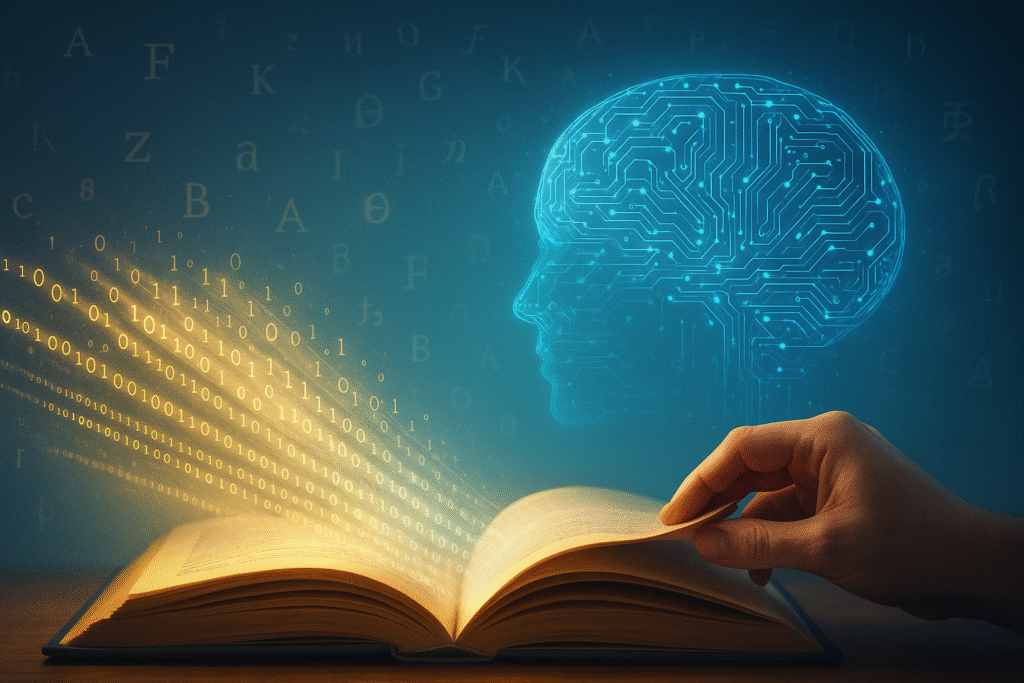
Will AI Replace Books? — The Future of Reading in the Age of Machines
By Arinze Achebe
1. The Question That Haunts the Future
Every new invention reshapes how humanity learns. The printing press democratized knowledge, the internet globalized it — and now, artificial intelligence personalizes it.
Yet a quiet fear lingers: With AI answering every question instantly, will anyone still open a book?
Will we trade the long silence of reading for the quick whisper of a machine’s reply?
This is not just a technological question — it’s a spiritual one. It touches the essence of how humans think, dream, and become.
2. What a Book Really Is
A book is more than pages bound together.
It is a vessel of consciousness, a captured spirit of someone’s long journey through thought and experience.
Every paragraph is an imprint of a human soul attempting to communicate truth across time.
When you read a book, you don’t just absorb facts — you inherit a mindset.
Books are where human silence becomes eternal voice.
AI may organize knowledge faster, but it cannot reproduce that sacred human slowness — the rhythm of a heart translating chaos into wisdom.
3. What AI Really Does
AI is not a replacement for books; it is a mirror of the knowledge that books have already built.
Every dataset that feeds AI was once written by a human, typed by a thinker, printed from a library, or stored in a digital archive.
AI, therefore, is not the origin — it is the reflection.
It stands on the shoulders of every author who ever existed.
Rather than ending the era of books, AI might become their new librarian — guiding readers to the right text, translating it, explaining it, even expanding upon it.
AI may teach us faster, but it cannot teach us deeper. Depth belongs to reflection, and reflection belongs to the reader.
4. Reading as Transformation
To read is to travel inward. It is to wrestle with ideas, to imagine, to create meaning with one’s own mind.
When you read, your brain rewires itself — you become something new.
But when you only consume answers from AI, you may receive information without becoming anything.
This is why the future needs both:
-
AI for speed — to connect ideas instantly.
-
Books for depth — to ground those ideas in meaning.
5. The Future of Books
Books will not die — they will evolve.
We will see books that talk, that interact, that adapt to readers’ emotions.
We will see AI narrators that bring books alive in many voices and languages.
But at the center of it all will still be the writer’s heart — because no algorithm can replace human experience.
As long as humans feel, suffer, hope, and dream, the book will remain — as testimony, as mirror, as map.
6. A Call to the Builders of Words
To the thinkers, writers, and dreamers of this new age:
AI will only be as wise as the words we give it.
So let us write with even greater fire.
Let us build libraries that breathe across screens, cultures, and generations.
Let us remind the world that AI learns from books — but humanity learns from reading.
Books are not dead.
They are about to be reborn — through us.