For decades, Nigerians have argued about what went wrong.
Some blame corruption.
Others blame tribe.
Religion. Leadership. Colonialism. Elections.
Each explanation sounds convincing.
None explains why the country keeps repeating the same failures—no matter who is in power.
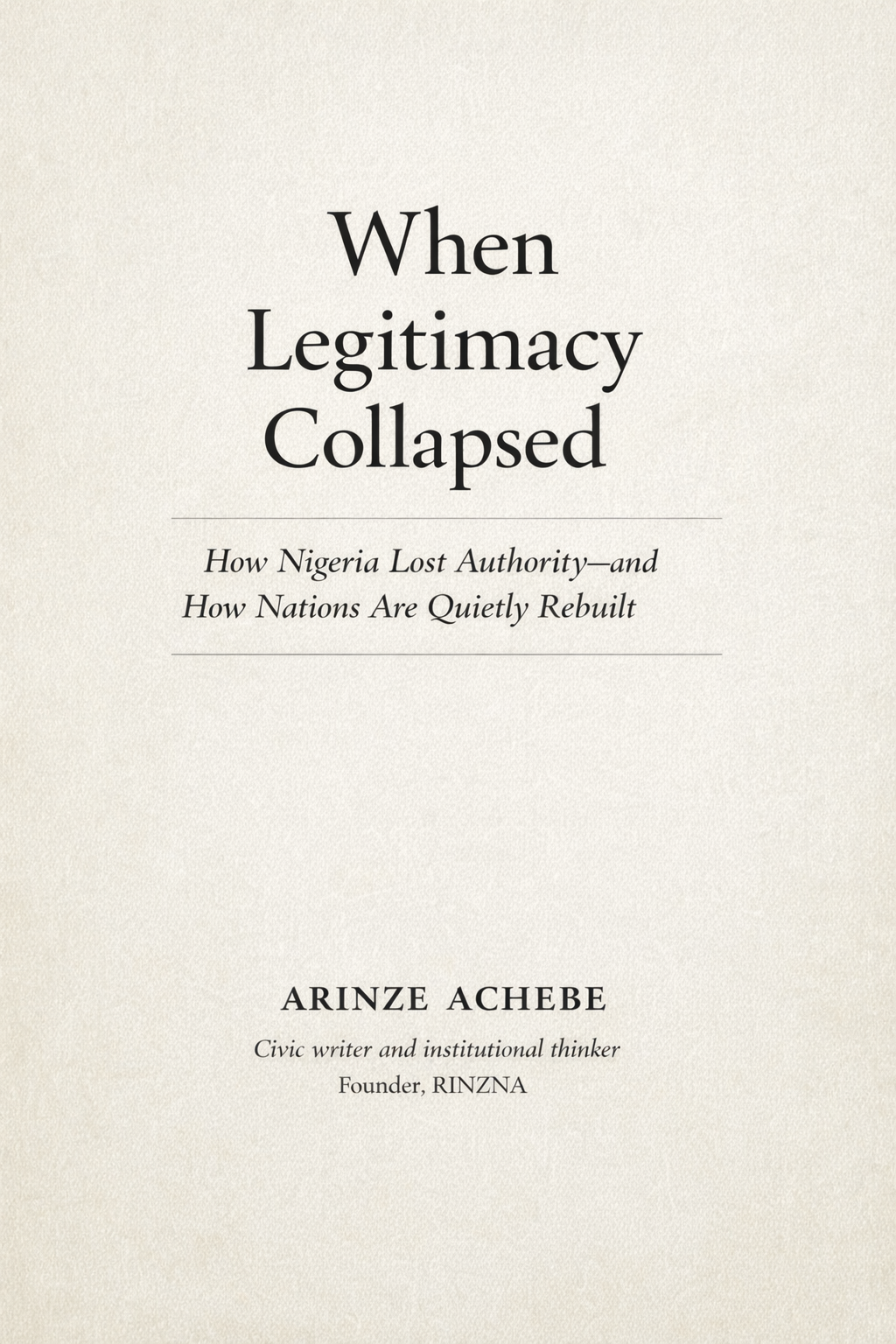
When Legitimacy Collapsed offers a different diagnosis.
This book argues that Nigeria’s core crisis is not moral, ethnic, or electoral—but structural: the collapse of legitimacy, the moment when authority stopped resting on consent and began relying on force, discretion, and fear.
Tracing this rupture from the events of 1966 to the present, the book explains why violence cannot restore order, why elections alone do not rebuild trust, and why waiting for heroes only deepens collapse.
More importantly, it shows how societies actually recover—quietly, non-violently, and durably—through standards, documentation, institutional memory, books, libraries, and a class of builders who work without applause.
This is not a manifesto.
It is not a call to anger.
It is not a promise of quick salvation.
It is a clear explanation of what legitimacy looks like in practice—and how it is rebuilt when it has been lost.
Written for readers who are tired of shouting and ready to understand, When Legitimacy Collapsed invites Nigerians to stop asking who will save the country—and to begin asking what must be built, patiently and permanently.